If you feel stuck in low Elo on FACEIT or CS2, you’re not alone. Many players grind game after game without seeing real progress or considering options like a faceit level boost. It’s easy to blame teammates, bad luck, or matchmaking. But more often than not, the issue is something more consistent and less obvious: your own patterns.
The challenge is that these patterns are hard to see in the moment. That’s where analytics tools come in. Instead of guessing what’s going wrong, you can use data to pinpoint exactly why you’re not climbing and what to fix.
Why You’re Stuck (And Don’t Realize It)
Most players rely on memory to judge their performance. The problem is that memory is biased. You remember your best rounds and forget your repeated mistakes. You might feel like your aim is the problem, when in reality it’s your positioning or decision-making.
Analytics tools remove that guesswork. They show trends across multiple games, not just a single match. Over time, this gives you a much clearer picture of your strengths and weaknesses.
Common hidden issues include:
- Low impact despite decent KDA
- Poor positioning leading to early deaths.
- Inconsistent performance across matches
- Weak utility usage or timing
Without data, these patterns stay invisible.
Step 1: Use the Right Analytics Tools
There are several tools that track your FACEIT or CS2 performance. Each one gives slightly different insights, but together they help you build a complete picture.
Some popular options include:
- FACEIT Stats (built-in and third-party trackers)
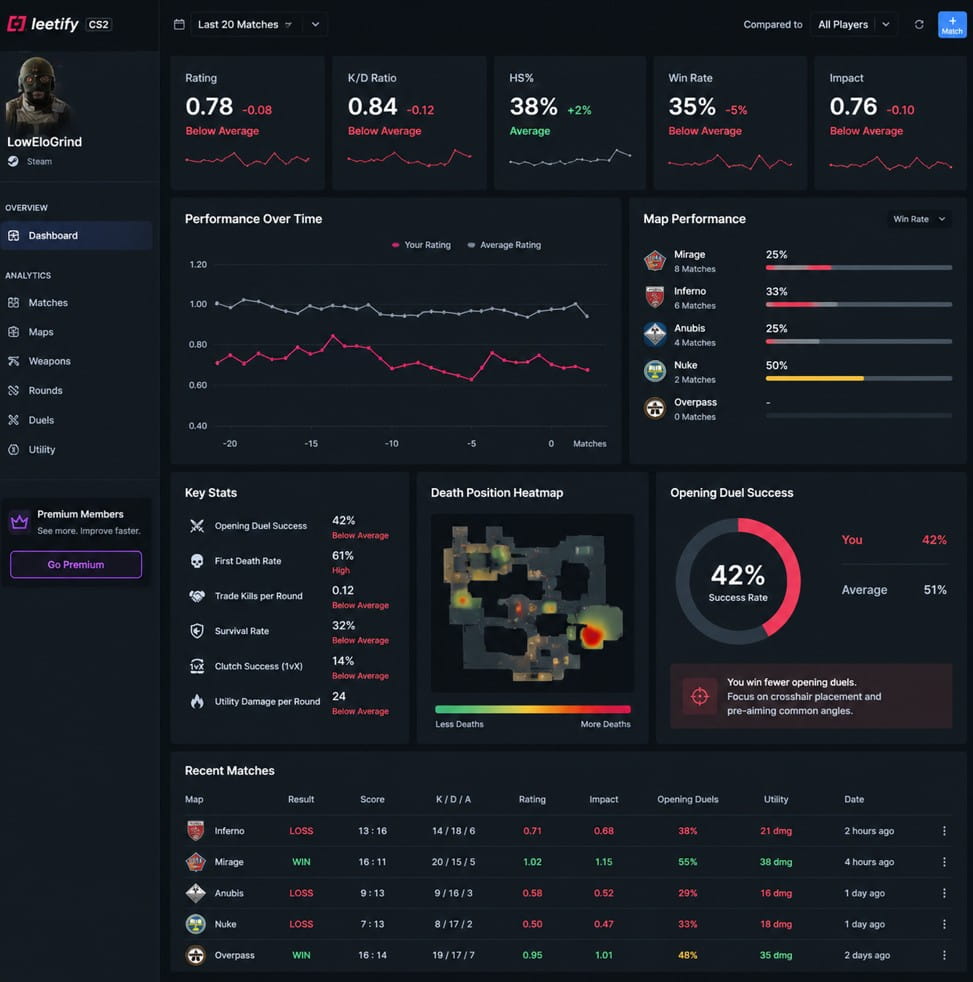
- Leetify for detailed performance breakdowns
- Scope.gg for advanced analytics and visual reports
These tools track metrics beyond simple kills and deaths. They analyze how you play, not just what your score looks like.
Step 2: Focus on the Right Metrics
Looking at the wrong stats can mislead you. KDA might look good, but it doesn’t always reflect impact. To improve, focus on metrics that actually affect winning.
Key metrics to pay attention to:
- Opening duel success rate
- Trade effectiveness
- Survival rate
- Utility usage
- Clutch success rate
These metrics reveal how you contribute to rounds, not just your personal scoreline.
Step 3: Identify Patterns, Not One-Time Mistakes
One bad game doesn’t mean much. What matters is consistency across multiple matches. Analytics tools help you spot recurring trends.
For example, you might notice:
- You die first in a large percentage of rounds.
- Your performance drops significantly on certain maps.
- Your aim is strong, but your positioning leads to unnecessary deaths.
These patterns are what keep you stuck. Once you see them clearly, they become much easier to fix.
Step 4: Break Down Your Role and Playstyle
Another common issue is playing without a defined role. Analytics tools can help you understand how you actually play compared to how you think you play.
Ask yourself:
- Am I playing aggressively or passively?
- Do my stats match my intended role?
- Am I contributing to team plays or playing solo?
For instance, if you think you’re an entry fragger but your opening duel success rate is low, that mismatch could be holding you back. Adjusting your role or improving specific skills can make a big difference.
Step 5: Compare Your Stats to Better Players
Most analytics platforms allow you to compare your performance with higher-ranked players. This is one of the fastest ways to understand the gap. Instead of guessing what good looks like, you’ll see it directly in the data.
Look at differences such as:
- Higher survival rates in key rounds
- Better utility efficiency
- More consistent performance across matches
- Stronger impact in early and late rounds
This gives you a clear benchmark. You’re not just trying to improve, you’re aiming to match specific performance standards.
Step 6: Turn Data Into Actionable Goals
Data alone won’t improve your rank. You need to translate insights into specific actions. The key is to focus on a few improvements at a time instead of trying to fix everything.
For example, if your analytics show a high number of early deaths, your goal could be:
- Play safer in the first 20 seconds of each round.
- Avoid unnecessary peeks without information.
If your utility usage is weak, you might focus on:
- Learning two or three key smokes per map
- Using flashes to support teammates instead of solo plays
Small, targeted improvements are more effective than trying to overhaul your entire playstyle at once.
Step 7: Track Progress Over Time
One of the biggest advantages of analytics tools is the ability to track improvement. Instead of relying on rank alone, you can see whether your performance is actually getting better.
Pay attention to trends like:
- Increasing survival rate
- Improved duel success
- More consistent match ratings
Even if your Elo doesn’t jump immediately, these improvements indicate that you’re on the right track. Over time, your rank will follow.
Common Mistakes When Using Analytics
While analytics tools are powerful, they can also be misused. Some players focus too much on stats without understanding context. Others get overwhelmed by too much data.
Avoid these mistakes:
- Obsessing over KDA instead of impact
- Ignoring team play metrics
- Trying to fix too many issues at once
- Not applying what you learn in actual games.
Analytics should guide your improvement, not replace gameplay experience.
Why This Works for Climbing Elo
Climbing in FACEIT or CS2 is not just about playing more games. It is about improving consistently. Analytics tools give you a structured way to do that.
Instead of guessing why you’re losing, you identify exact weaknesses. Instead of repeating the same mistakes, you correct them with intention. Over time, this leads to more consistent performance and better results.
Players who climb are not always the most mechanically skilled. They are the ones who understand their game and make smarter decisions.
Final Thoughts
Being stuck in low Elo can feel frustrating, especially when you’re putting in the time. But improvement doesn’t come from playing more alone. It comes from understanding your gameplay and fixing what’s holding you back.
Analytics tools give you that clarity. They turn your matches into data, your data into insights, and your insights into improvement. If you start using them correctly, you’ll stop guessing and start progressing. And that’s the difference between staying stuck and finally climbing.